
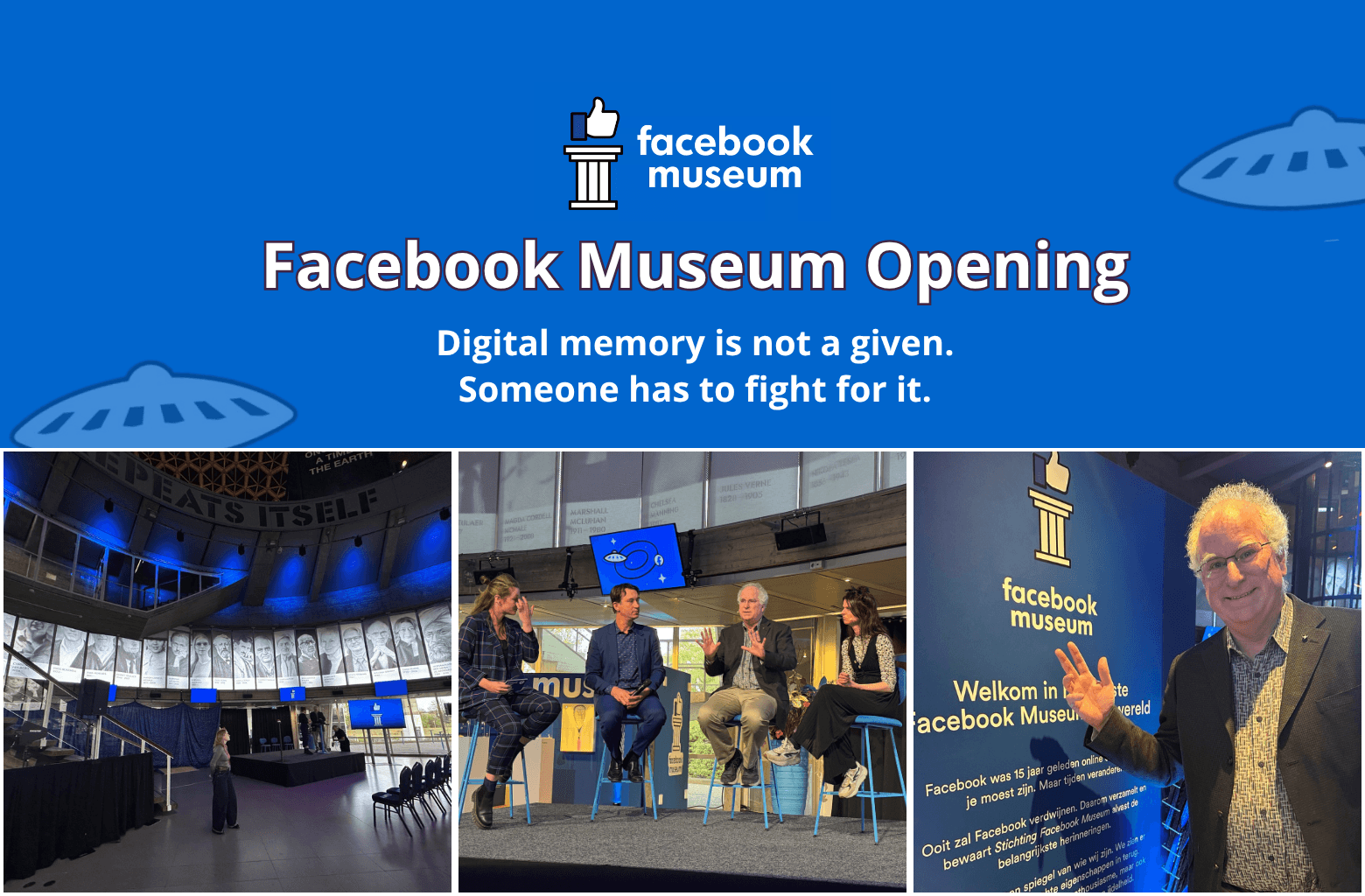
On 10 April, Internet Archive Europe joined SETUP and the Next Nature Museum in Eindhoven for the opening of the Facebook Museum, a project that asks a question most of us avoid: why can’t we let go of the platforms that hold our lives?
The evening brought together Brewster Kahle, founder of the Internet Archive, researcher Marissa Memelink, cultural sociologist Siri Beerends, and Koert van Mensvoort, Next Nature Director, for a conversation that moved quickly from nostalgia to urgency.
Kahle traced the arc of digital communities from FIDO Net and GeoCities to MySpace, Vine, and Twitter, not as a history lesson but as a warning. These platforms held real communities, real memories, real voices. Most are gone. What survives lives in the Wayback Machine. “People want to share what they know,” he said, “and they’re awesome.” The problem is what happens to that sharing when it sits on someone else’s servers, subject to acquisition, shutdown, or deletion without notice.
The panel pushed on something harder than technical preservation: trust. A Facebook Museum visitor had described their account as an external hard drive, assuming the data would simply be there whenever they needed it. Kahle was direct. That assumption is false, and most people know it, in the way you know your phone photos might not be backed up, but do not act on it. The question is not just how to save things. It is how to build systems that people can actually trust enough to rely on.
That question has a political answer. Kahle pointed to the stakes for Europe specifically. If the continent does not build public digital infrastructure, including public AI trained on cultural heritage, the choice will narrow to American or Chinese models. “That is not good enough,” he said, “and we have the technologies to do something about it.”
The decentralised web offers a different model: protocols instead of platforms, data you actually own, switching costs that do not feel like surgery. This vision is being practicalised at events like DWeb Camp, which moves to Europe for the first time this July in the forests of Brandenburg, close to Berlin, Germany. By gathering technologists, artists, and policymakers to build “root systems” for a more resilient internet, the camp serves as a living laboratory for these principles. The path is not easy, but the direction is clear.
This is exactly the work Internet Archive Europe exists to support. Preserving the web is how societies remember who they were and what they chose to build. It is too important to ignore.
The Facebook Museum runs at the Next Nature Museum in Eindhoven through September 2027, and the Internet Archive Europe looks forward to a continued partnership with SETUP Media Lab.

