

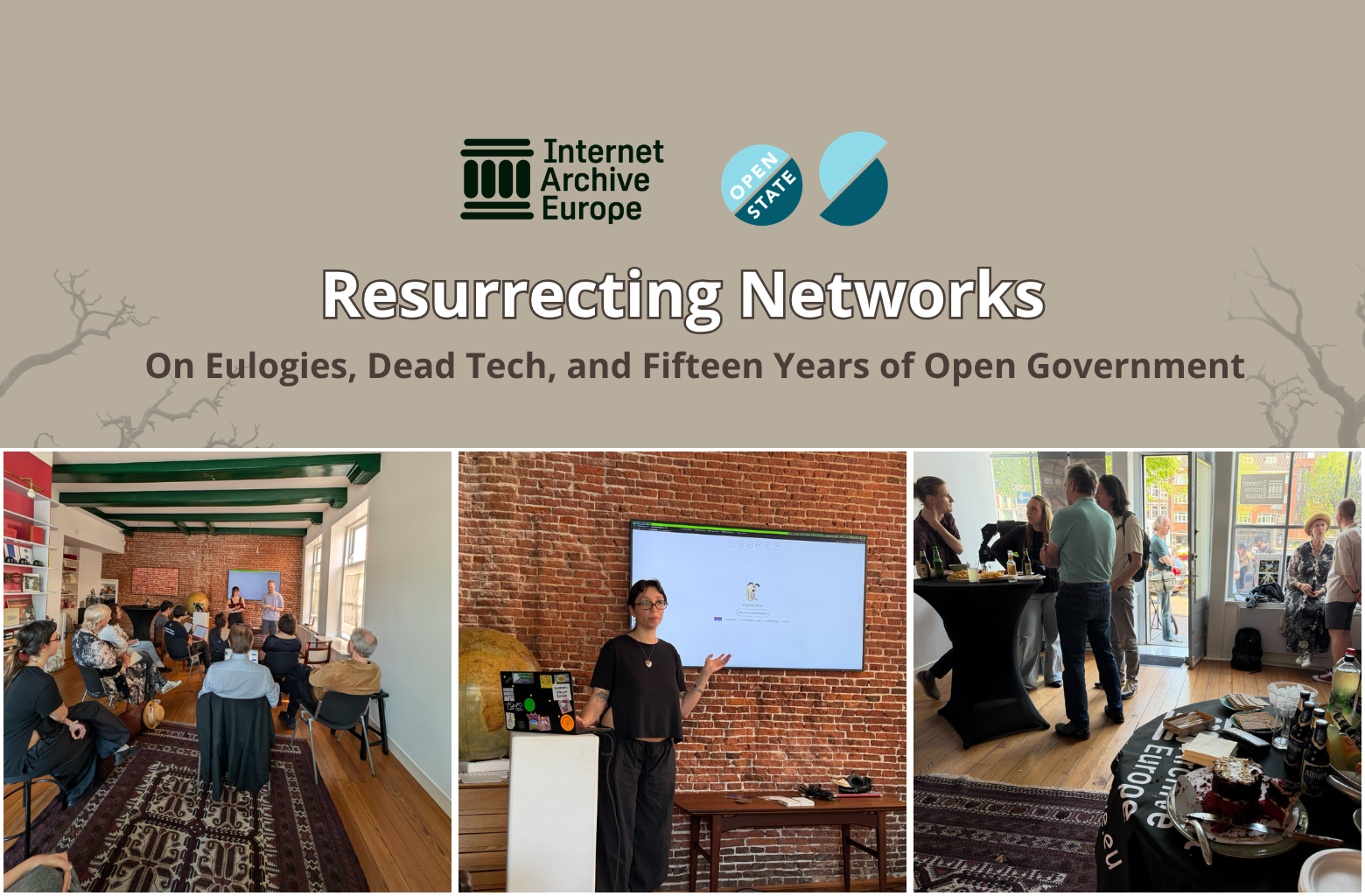
On Friday 22 May, Internet Archive Europe’s Amsterdam space hosted two very different events that, in retrospect, belonged together.
A Funeral for the Networks We Lost
The afternoon began with Resurrecting Networks, a workshop led by Sevgi Tan that asked participants to do something rarely granted in tech culture: slow down and grieve.
Tan’s practice draws on media archaeology and Mary Shelley’s Frankenstein, taking deprecation seriously as an event worth marking. The premise is simple and slightly radical. When a network dies, it doesn’t just disappear. It takes with it communities, habits, ways of communicating, and forms of trust that were specific to it. AOL chat rooms were not just a primitive version of Slack. MSN Messenger was not merely a precursor to WhatsApp. They were particular places, with particular people in them, and when they went, something real was lost.
Participants arrived in funeral attire, as requested. Together, the group built a graveyard: a collective list of dead networks. Then came the eulogies. Some people wrote short paragraphs. Some read poems. Some brought physical objects. Singing was involved. The format was deliberately open, the mood somewhere between solemn and warm.
What made the session land wasn’t nostalgia, exactly. It was the act of paying attention. Tan’s framing insists that slowing down around technological loss is a form of resistance to the consumerist logic that treats obsolescence as natural, inevitable, and not worth mourning. If we want to understand what we’re building now, it helps to understand what we’ve already buried and why.
For an organisation that archives the web, that question is never abstract. What survives depends on choices: what gets collected, what gets preserved, what gets remembered. Resurrecting Networks made those choices visible and personal.
Fifteen Years of Open Government, Celebrated with Cake
The borrel that followed brought a different energy. Together with Open State Foundation, IAE marked fifteen years of the Open Government Partnership as part of Open Government Week, an annual moment when countries and civil society organisations across the world take stock of what transparent, accountable governance actually looks like in practice.
There were drinks, Affligem, Fritz Kola, red velvet cake, and the kind of conversations that don’t fit neatly into a programme. A short presentation anchored the afternoon at 16:00, but the real work of the evening happened in the margins: practitioners, archivists, and open government advocates comparing notes, making connections, and arguing about what progress looks like.
The Open Government Partnership launched in 2011 on the premise that governments perform better when they operate in the open. Fifteen years on, the gaps between commitment and practice remain wide in many places. But the coalition has grown, and the principle has held.
For IAE, open government and digital preservation are not separate issues. Archives are how accountability becomes possible over time. A government that controls what gets preserved controls, in the end, what can be known about it. Open access to public records, open data, and the right of memory institutions to collect and keep digital materials are all parts of the same argument.
The afternoon made that connection visible, without needing to say it out loud.
Both events are over, but the questions they raised aren’t. If your organisation works in this space, we’d love to hear from you.

