

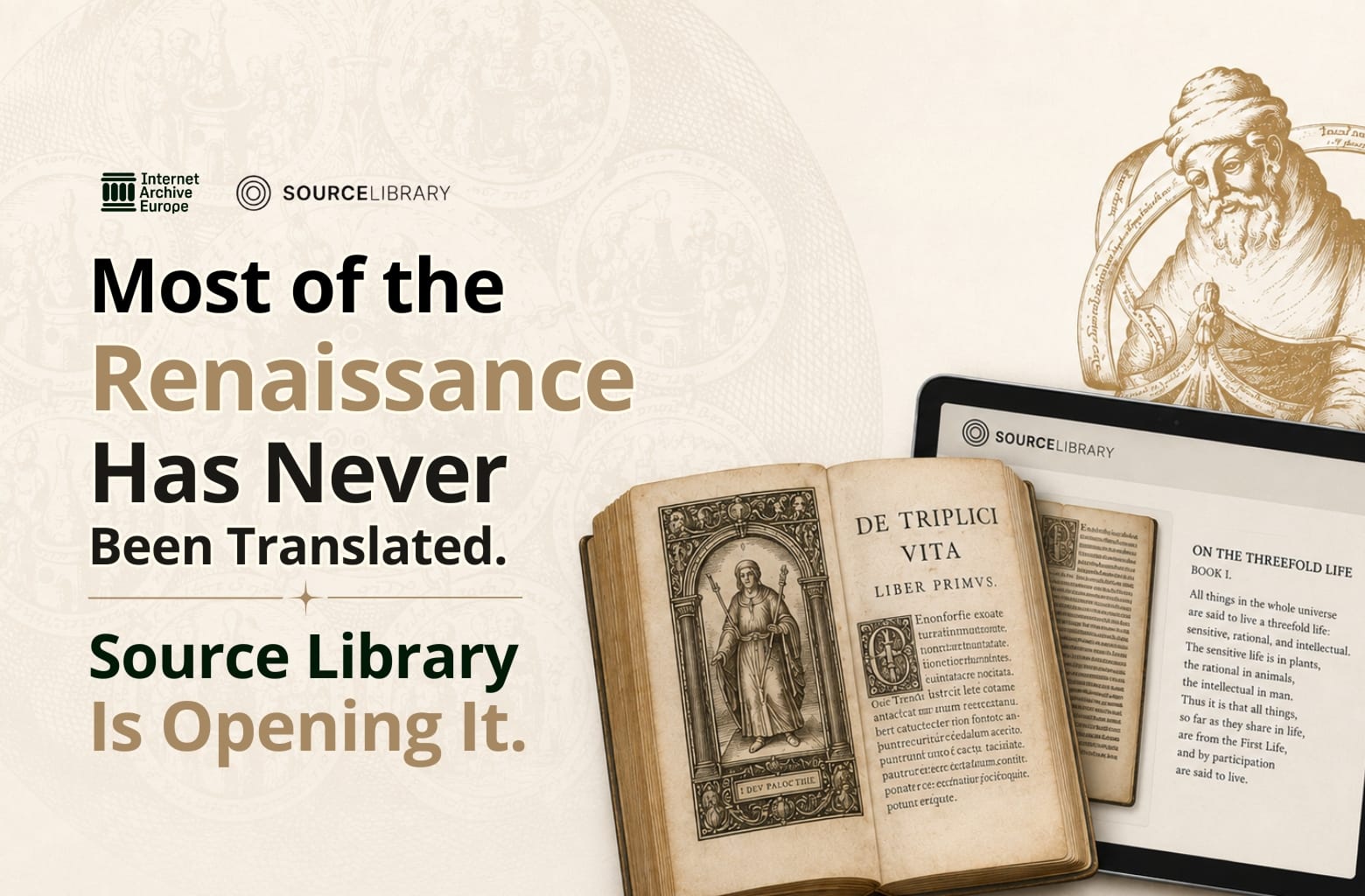
Ninety percent of Renaissance Latin has never been translated into a modern language. More Latin was written after 1500 than survives from all of ancient Rome, and almost none of it has been read outside a specialist library. At the current pace of human scholarship, completing that translation work would take approximately 12,000 years.
On 4 June, Internet Archive Europe attended the Source Library BETA Launch at the Embassy of the Free Mind in Amsterdam. It was a milestone worth marking.
What Source Library Is
Source Library is the world’s largest freely available collection of translated historical primary sources from the Renaissance. At launch, it holds more than 15,000 books across 55 languages, including 6,000 first-ever English translations and roughly seven billion words of original text and translation, comparable in scale to the entire English Wikipedia. Works previously readable only by Latin scholars or locked behind expensive academic editions are now open to anyone.
The project is hosted at the Bibliotheca Philosophica Hermetica, the UNESCO Memory of the World-recognised collection at the Embassy of the Free Mind: more than 25,000 volumes on alchemy, Hermetica, Kabbalah, Rosicrucianism, and the roots of modern science. Many of these books were banned at various points in history. Now they are open.
The launch carries particular meaning in light of what followed. Joost Ritman, the Amsterdam businessman who founded the Bibliotheca Philosophica Hermetica and built it into one of the world’s great collections of philosophical, religious, and esoteric knowledge, died on 5 June 2026, the day after Source Library launched in the institution he founded . He had spent sixty years guided by a conviction he traced to the Florentine Medici: that those in a position of privilege carry an obligation to culture. In 2017, he donated the library, its research institute, and the House with the Heads Monument to a cultural non-profit foundation, publicly known as the Embassy of the Free mind. This was a gift to Amsterdam and the world: he made permanent what he had spent his life assembling, and he made it public.
AI as Accessibility, Not Replacement
Source Library places AI-powered translations directly alongside images of the original source pages, so anyone can consult the original at any point. The goal, as project creator Dr. Derek Lomas of Delft University of Technology made clear at the launch, is not to replace scholarship but to make a vast body of untranslated material discoverable for the first time. Dr. Lomas is a cognitive scientist and human-computer interaction researcher, currently a professor of Human Centred Design at Delft University of Technology, who arrived at Renaissance philosophy through a long personal engagement with the Neoplatonic tradition. That combination gives Source Library a design sensibility that most digital archive projects lack: the design starts from how people actually discover and engage with material, not from how institutions prefer to organise it.
Dr. Lomas and the team also maintain careful transparency about data sources throughout: content drawn from the library’s own catalogue is clearly distinguished from AI-generated material, and all translations record the model, date, and prompt used to produce them. That distinction matters. The AI output is treated as useful but revisable. The primary sources are treated as the foundation it is, complimented by academic curatorial work.
The project carries an AGPL-3 licence, the same open source licence used by the Internet Archive. It draws on open digital image standards that allow libraries and archives to share their collections freely, and it acknowledges the institutions whose digitised holdings made the work possible.
Why This Matters
The question Source Library poses is one we encounter constantly: who gets to access knowledge, and on what terms?
For centuries, the thought documented during the Renaissance has been available only to those who read Latin, have access to specialist collections, or can afford expensive critical editions. Source Library removes those barriers. It doesn’t replace careful scholarship. It makes a vast body of human thought discoverable for the first time.
This is open access made concrete: 6,000 first translations, 55 languages, no paywalls. It also matters for AI. The training data available to language models shapes what they know and how they reason. A Renaissance that remains untranslated is a Renaissance that AI cannot draw on. Source Library is building the corpus that public-interest AI will need.
Explore Source Library at sourcelibrary.org.

