Beatrice Murch

Oudeschans, Old Ramparts and New Guardians: Reflections on the Internet Archive Europe Open House

Last week, the new headquarters of Internet Archive Europe at Oudeschans came alive with voices, laughter, ideas, and shared commitment. What had been a milestone in planning and construction became, for a few hours, something far more alive—an affirmation of what it means to protect, to remember, to build for the future.

The Rampart of Oudeschans: History, Meaning, Metaphor

To stand at Oudeschans is to feel history underfoot: the Old Rampart dates back to Amsterdam’s early 16th century, when a canal, moat, and wall were constructed to protect the eastern flank of the city. These earthen walls, wooden palisades, and waterworks defended Amsterdam from external threats, serving as vital structures of protection. As time passed, the military purpose of the walls faded. The ramparts were gradually absorbed into urban growth, as canals, quays, neighborhoods, and the daily lives of Amsterdam’s citizens evolved. What had once been a bulwark against danger became part of the living city.

And on that open house day, Internet Archive Europe embraced that same legacy, the responsibility of being a living rampart for memory.

Defending Memory in a Digital Age

Why does Europe need a rampart of memory today? Because digital content is peculiarly fragile:

  • Websites vanish. Links rot. Formats become unreadable.
  • Cultural artifacts stored only digitally can be lost without proper infrastructure or foresight.
  • Legal, technical, and funding challenges threaten access to knowledge.

In this sense, the Internet Archive Europe is building something essential: walls of protection, yes — but also channels of access, transparency, collaboration. Not isolation, but integration: with libraries, with AI, with policy, with the public.

Faces Old and New: The Community Comes Together

The event was, above all, a gathering of friends—those who have walked alongside Internet Archive Europe from its early days, and many who are meeting its mission freshly, for the first time.

  • Among the old friends were heritage librarians, digital preservation experts, longtime collaborators from European libraries and museums, and policy advocates who have argued for open access and digital rights. These people know the fragile terrain: disappearing websites, vanishing metadata, legal grey zones.
  • The new friends included technologists drawn by the promise of public AI tools; scholars excited by what “bringing collections to life” could mean; younger activists and students eager for ways to help safeguard memory; and representatives of smaller language communities and underserved institutions who saw potential for more equitable access and new infrastructure.

Together, old and new, they wove conversation: what is being preserved, how, for whom, and what tools are truly needed to keep memory alive.

Words and Code: Visions for a Shared Future

The buzz of conversation gave way to a series of inspiring presentations that framed the day’s purpose. 

Brewster Kahle, digital librarian and founder of the Internet Archive Europe, perfectly captured the spirit of the event. He envisioned the historic location as a place where this “17th century building… can once again help foster openness with new technologies” as we all “strive for a healthy information ecosystem.” The ultimate goal, he explained, is not to create “a game of a few big winners,” but to build a system where “everyone prospers based on our shared cultural heritage.” This collaborative ethos was echoed by Wilma Van Wezenbeek, General Director of the KB Nationale Bibliotheek, and further explored by voices from the technological frontier, including Daniel Erasmus of Digital Thinking Network Foundation, Ben Cerveny from the Foundation for Public Code, and Kai Jauslin of Nextension.

This vision was made tangible through compelling live demonstrations, where Daniel, Ben, and Kai presented different tools that harness AI for the public good with Climate GPT, the Web Archiving display, and the Spacecraft experience. Attendees witnessed firsthand the novel ways in which memory organizations can bring collections to life, creating new pathways for discovery and interaction with our shared history.

Conclusion: Custodians of Our Future Memory

As the old ramparts of Amsterdam once protected lives, commerce, and ideas, so too is Internet Archive Europe aiming to protect our collective past to enable our collective future.

What we preserve now will be what our future selves can touch, learn from, and build on. Internet Archive Europe’s open house was a reminder that memory, digital and analog, must be defended—not by walls alone, but by hands, minds, policies, and trust. Let’s ensure that what matters — knowledge, culture, memory — is not lost but sustained, accessible, alive.

Join Us

The Internet Archive Europe Headquarters is thrilled to announce it will soon offer weekly reading room hours and play host to the Open World community with lectures, meetups, and hackathons. We welcome your participation, so please sign up to our quarterly newsletter and stay up-to-date with our activities and projects. 

Internet Archive Europe Open House, 19 September 2025

Photo credit: “Internet Archive Europe Open House, 19 September 2025” by Sebastiaan ter Burg, CC BY 4.0

Oudeschans, Old Ramparts and New Guardians: Reflections on the Internet Archive Europe Open House Read Post »

Preserving Digital Sovereignty: Reflections on Brewster Kahle’s Intervention at the KB

On 17 September, the KB – National Library of the Netherlands hosted an inspiring gathering on the theme of digital sovereignty and the future of web archiving, featuring Marleen Stikker (Waag Futurelab) and Brewster Kahle (Internet Archive / Internet Archive Europe). The event brought together colleagues from OCW, the Rijksmuseum, Europeana, UNESCO, Beeld & Geluid, the Hilversum Time Machine, and many others — a true community committed to safeguarding our shared digital heritage.

Setting the Stage: Why the Web Matters

The session began with Sophie Ham from the KB introducing the national web collection. As she noted, “Our life is on the internet and that is worth preserving.” She reminded the audience that the Dutch web, though relatively small, is of unique historical significance. The Netherlands was already present on the internet in 1985, and remarkably, the third and fourth websites ever created were hosted here.

Sophie emphasized how the Internet Archive has been an invaluable partner in capturing material from before 2007 (when the KB’s own archiving began), and continues to provide preservation capacity that Dutch institutions cannot yet fully pursue due to legal restrictions.

Marleen Stikker on the Digital City and Public AI

Marleen Stikker, in conversation with Martijn Kleppe, revisited De Digitale Stad — the pioneering 1990s digital community. As its former “mayor,” she recalled both the promise and the early challenges of online communication.

Her message was clear: if we want democratic and open digital infrastructures, we must invest in Public AI, built on European values, as articulated in Paul Keller’s recent white paper. Just as De Digitale Stad was once a civic experiment in digital space, today’s moment calls for a renewed commitment to public digital institutions.

Brewster Kahle: Putting Collective Memory at Our Fingertips

Closing the afternoon, Brewster Kahle of the Internet Archive Europe shared reflections on nearly three decades of global web preservation.

He began by warmly thanking XS4ALL and KPN for years of server support, and Beeld & Geluid for taking on this role moving forward. He noted that the Internet Archive is fast approaching the milestone of one trillion websites preserved. For Kahle, this work rests on a simple truth: “People are awesome. People want to share, and what they share is worth preserving.”

Kahle too called for Public AI, not dominated by corporate interests but rooted in European values and democratic accountability. He illustrated the potential of AI trained on public knowledge with the example of Leiden University dissertations — documents unlikely to be read by many humans, but which could fuel new discoveries when made accessible to machines.

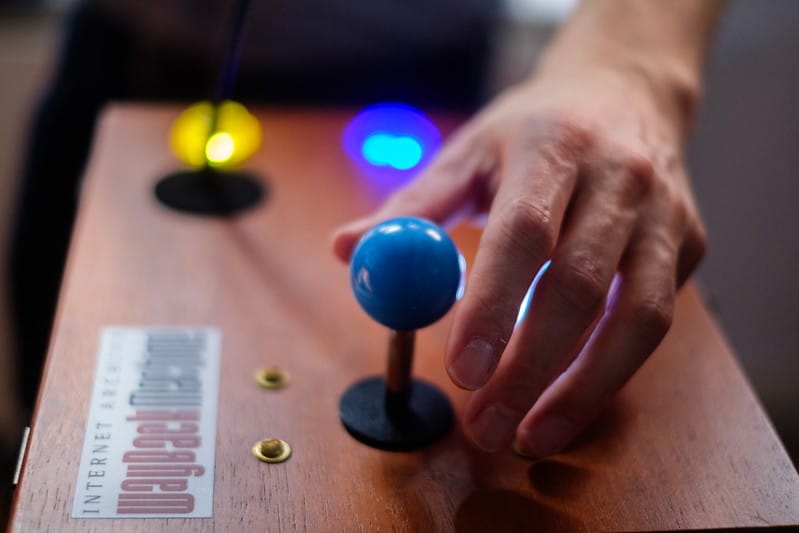
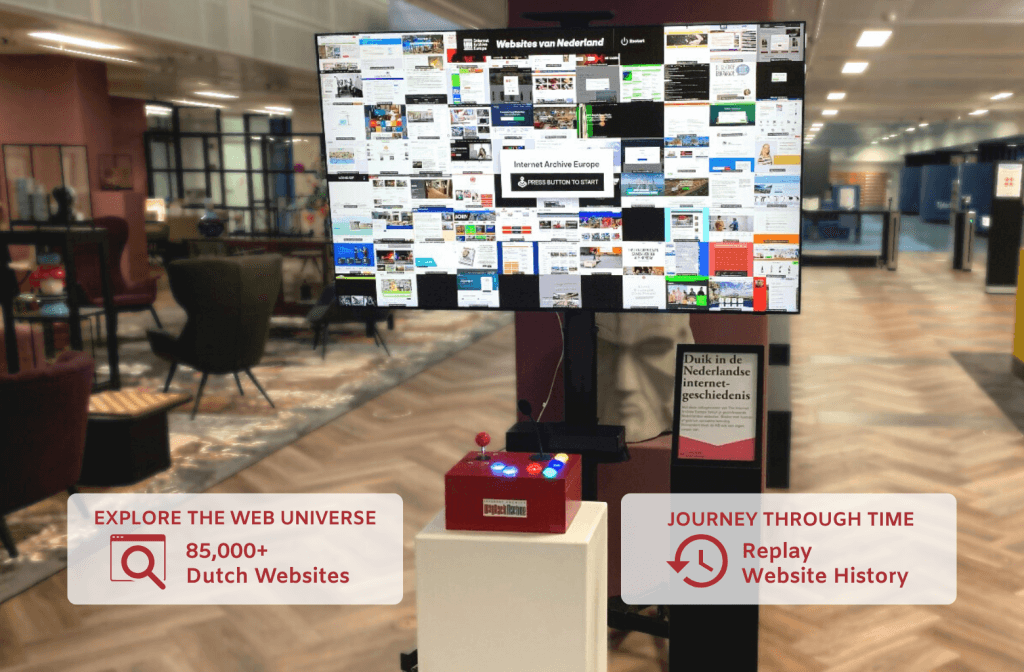
Perhaps the most tangible expression of this vision was the unveiling of a new interactive machine installed at the KB. Visitors will be able to explore the Dutch web as preserved in the Internet Archive’s collections until 11 October, culminating in The Hague’s Museum Night. More than just a tool, this machine embodies the possibility of placing our collective memory directly at each individual’s fingertips. It demonstrates how digital preservation is not about storing data in the abstract, but about making the richness of the past immediately usable, searchable, and alive for today’s citizens.

This is what “bringing collections to life” truly means — connecting people with the traces of their own digital history and empowering them to use that knowledge to understand the present and imagine the future. And this is at the heart of Internet Archive Europe’s mission: to ensure that Europe’s digital memory is not only safeguarded, but also activated, accessible, and meaningful to all.

Looking Forward

The event at the KB was more than a discussion: it was a reminder that preserving the internet is not just a technical task, but a cultural, democratic, and civic responsibility. It highlighted the importance of collaboration — between libraries, archives, technologists, and policymakers — in ensuring that Europe’s digital memory remains accessible for future generations.

As Brewster Kahle put it, what people share online is worth keeping. And with initiatives like Internet Archive Europe, anchored in Amsterdam, we are taking meaningful steps to safeguard that shared heritage — and to build public digital infrastructures that can meet the challenges of the 21st century.

Preserving Digital Sovereignty: Marleen Stikker & Brewster Kahle at the KB

Photo credit:Preserving Digital Sovereignty: Marleen Stikker & Brewster Kahle at the KB” by Sebastiaan ter Burg, CC BY 4.0

Preserving Digital Sovereignty: Reflections on Brewster Kahle’s Intervention at the KB Read Post »

Internet Archive Canada Signs the Four Digital Rights Statement

The Our Future Memory movement to secure digital rights for memory institutions has taken another step forward. Internet Archive Canada has signed the Statement on the Four Digital Rights of Memory Institutions—and has gone further by ensuring the Statement is now available in French.

This translation opens the campaign to millions more people across Canada, Europe, Africa, and other Francophone regions, strengthening the inclusiveness of the global effort. Making the Statement accessible in different languages ensures that its principles resonate not just within professional circles but with communities everywhere that depend on libraries, archives, and cultural institutions.

Internet Archive Canada’s initiative builds on other international contributions. Thanks to the University Library “Svetozar Markovic” in Belgrade, a Serbian translation is also available, helping to spread the campaign across Central and Eastern Europe.

Together, these efforts highlight that the campaign is not only about four essential rights—

  1. Right to Collect
  2. Right to Preserve
  3. Right to Lend
  4. Right to Cooperate

—but also about making those rights understandable and actionable across languages and cultures.

Call for Volunteers Among our Signatories

The success of the campaign depends on broad participation. We are now looking for volunteers from our signatories to draft additional translations of the Statement. Each new version brings more people into the conversation, amplifying the call for legal frameworks that allow memory institutions to thrive in the digital age.

If you can help, please get in touch at campaigns@internetarchive.eu. By working together, we can ensure these rights are embraced worldwide—because preserving our future memory is a global task.

Internet Archive Canada Signs the Four Digital Rights Statement Read Post »

Unlocking Europe’s Digital Bookshelves: The Fight for Our Right to eRead

Libraries have always been society’s great equalisers—gateways to knowledge, culture, and opportunity, open to everyone. But as the world moves from print to pixels, the fundamental ability of libraries to own and lend books is under threat. This isn’t just an inconvenience; it’s a direct challenge to our collective right to access digital materials, the third core principle of the Our Future Memory campaign supported by Internet Archive Europe.

Two recent publications shed crucial light on this struggle, mapping out both the problem and the path forward for memory institutions across Europe.

From Ownership to Expensive, Temporary Access

The core of the problem is a seismic shift in how we access digital content. As a recent COMMUNIA policy paper highlights, publishers are increasingly moving away from selling digital materials and are instead offering restrictive licenses. For libraries, this means they can no longer simply buy a book and own it forever. Instead, they’re trapped in a cycle of temporary, rental-like agreements that give publishers unprecedented control.

The consequences are stark. Libraries face exorbitant prices, “take it or leave it” subscription bundles filled with titles they don’t need, and terms that can forbid preservation, accessibility services, or inter-library loans. In some cases, publishers can even refuse to license essential e-books altogether, effectively creating gaps on our shared digital shelves. This reliance on licensing, a comprehensive study on e-lending in Europe by Knowledge Rights 21 concludes, “undermines the societal role of libraries by limiting their operational capabilities” and compromises fundamental user rights like privacy.

A Path Forward: Secure Digital Lending and the Right to License

So, what’s the solution? The Knowledge Rights 21 study offers a powerful, legally grounded model: (independent) Secure Digital Lending ((i)SDL)

This model is simple and fair: if a library legally owns a physical copy of a book, it should have the right to digitise it and lend out that single digital copy to one user at a time. This “one copy, one user” system mirrors traditional library lending and provides a vital backstop when publishers refuse to offer fair licensing terms. The study compellingly argues that this model is permissible under existing EU law, offering a clear path for libraries to reclaim their autonomy in the digital age.

The COMMUNIA policy paper builds on this by calling for broader legislative change. It argues that because access is a prerequisite for exercising rights like education and research, users need an enforceable “ancillary access right”. For libraries, this means an obligation on publishers to facilitate access through fair and reasonable licenses. Critically, any licensing terms that prevent a library from fulfilling its public mission—such as by charging unfair prices or restricting lawful uses—should be unenforceable.

Join the Conversation

To dive deeper into these critical issues, join the upcoming COMMUNIA Salon on “The Right to E-Lend.” This online event will be moderated by Peter Routhier from the Internet Archive and will feature experts discussing the challenges and solutions outlined in these essential reports. It’s a perfect opportunity to engage with the community and explore how we can collectively build a better digital future for our libraries.

Stand for Our Future Memory

Both of these reports arrive at the same conclusion: the current system is failing our libraries and, by extension, all of us. Securing the right to access, own, and lend digital materials is not a niche issue: it’s essential for ensuring that knowledge remains a public good, not a private, pay-per-view commodity.

This is precisely what the third right of the Our Future Memory campaign is all about. The ability of our memory institutions to build and preserve digital collections for future generations depends on our ability to act now.

The digital transformation of knowledge will continue regardless of whether memory institutions effectively advocate for their needs.

If your institution believes in a future where digital knowledge is owned, preserved, and accessible to all, it’s not too late to show your support. Join the growing list of signatories and stand with us.

Sign the statement at: www.ourfuturememory.org

Unlocking Europe’s Digital Bookshelves: The Fight for Our Right to eRead Read Post »

Preserving Digital Sovereignty: Marleen Stikker & Brewster Kahle at the KB in The Hague on 17 September

Exploring the Urgency of Web Archiving in the Netherlands

In an era where websites disappear and change at a rapid pace, safeguarding our digital cultural heritage has never been more urgent. On Wednesday 17 September, the KB – National Library of the Netherlands in The Hague will host a timely event featuring Marleen Stikker, internet pioneer and founder of Waag Futurelab, and Brewster Kahle, founder of the Internet Archive and Internet Archive Europe.

This gathering will focus on the need for robust web archiving in the Netherlands. Despite efforts by Dutch institutions like the KB, the Netherlands Institute for Sound and Vision, and the National Archives, legal restrictions severely limit the ability to comprehensively preserve Dutch websites. As a result, vast portions of the Dutch digital memory risk being lost.

A Conversation on Collective Memory and Democratic Infrastructure

The event will spotlight how digital preservation supports historical awareness, collective memory, and a functioning democracy. Marleen Stikker will address why digital sovereignty matters in today’s political and cultural landscape, while Brewster Kahle will showcase the Internet Archive’s efforts to preserve the web globally since 1996—including new ways to explore archived websites and bring collections to life.

Their insights will be particularly valuable for policymakers, cultural heritage professionals, and digital preservation advocates. The discussion will be held in English.

Event Details

Date: Wednesday 17 September 2025
Time: 15:30–17:00, followed by a reception
Location: KB | National Library of the Netherlands, Prins Willem-Alexanderhof 5, 2595 BE The Hague
Language: English
Audience: Heritage sector professionals and advocates, policymakers, and invited guests

👉 Register here to attend the event and more info here.
(Note: Limited capacity; early registration recommended)

Preserving Digital Sovereignty: Marleen Stikker & Brewster Kahle at the KB in The Hague on 17 September Read Post »

Brewster Kahle at the Royal Danish Library in Copenhagen on 4 September

Digital librarian and founder of the Internet Archive, Brewster Kahle, will deliver a public lecture introducing Internet Archive Europe in Copenhagen on Thursday, September 4, 2025, from 13:00 to 14:15 CET. The event will take place at the Royal Danish Library, Karen Blixens Plads 7, Grand Lobby, Copenhagen.

📢 Register here to attend the event.

Brewster Kahle and Universal Access to All Knowledge

Brewster Kahle has dedicated his career to creating a digital library accessible to all, preserving over 145+ petabytes of data—including books, web pages, music, television, and software. The Internet Archive collaborates with 1,200+ library and university partners worldwide to safeguard cultural heritage and enhance public access to knowledge.

Internet Archive Europe, a Dutch foundation established in 2004, expands this mission of Universal Access to All Knowledge through partnerships with European libraries, museums, and archives, working to safeguard digital heritage for the long term. 

Introducing Internet Archive Europe to Denmark

As Internet Archive Europe deepens its collaborations across the continent, this lecture brings its mission into focus for a Danish audience. Brewster will share how collaborations can build a shared infrastructure for digital preservation across borders.

Key discussion topics will include:

  • Building partnerships between Internet Archive Europe and mission-aligned European cultural and research organisations.
  • Exploring how AI can be used to “bring collections to life” for researchers, patrons, and the public.
  • Addressing the unique opportunities and challenges of digital libraries in the European context.
  • Enhancing the accessibility and visibility of cultural heritage collections through collaborative innovation.

A Public Dialogue on the Future of Digital Memory

Co-hosted by DALOSS and Royal Danish Library, this event invites academics, librarians, policymakers, and the public to reflect on the challenges and opportunities facing Europe’s digital future.

📅 Event Details:
📍 Location: Royal Danish Library, Karen Blixens Plads 7, Grand Lobby, Copenhagen
🕓 Date & Time: Thursday, September 4, 2025 | 13:00 – 14:15 CET
🔗 Register here and check here for more information

 🗣️ Language: English 🇬🇧

This is a unique opportunity to engage in a forward-looking discussion on AI, open access, and cultural heritage with one of the leading voices in the field of digital preservation.

Brewster Kahle at the Royal Danish Library in Copenhagen on 4 September Read Post »

Scroll to Top