

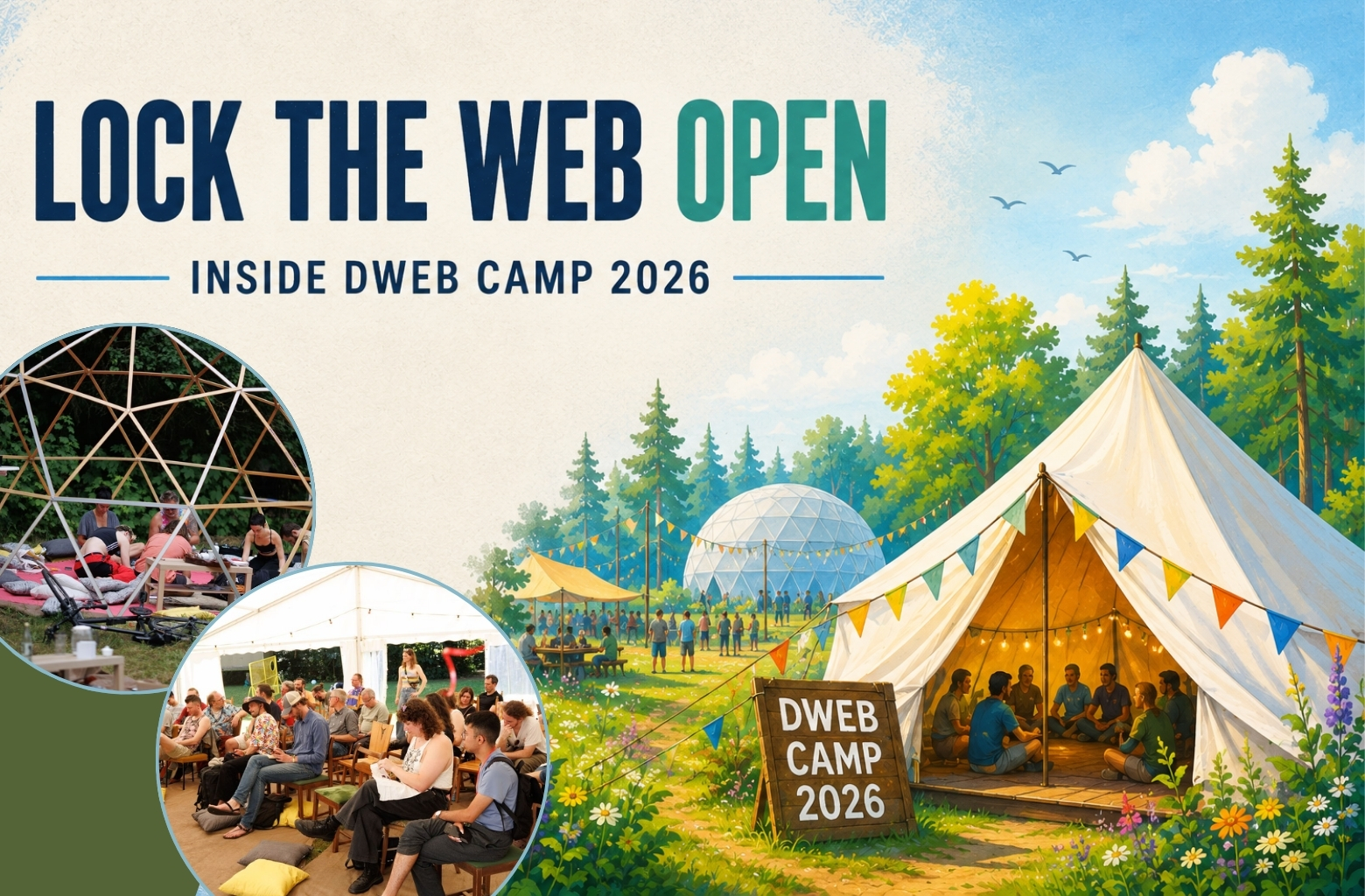
Last week, in an ancient forest an hour outside Berlin, more than 500 builders, researchers, archivists, and artists gathered to ask the same question in a hundred different ways: how do we build a web that cannot be switched off, sold, or shut down. Internet Archive Europe helped bring it there.
Ten Years On, First Time in Europe
For the first time in its ten-year history, DWeb Camp left the redwoods of Northern California. This year it landed at Alte Hölle, a former Stasi recreation site now home to a collectivist community, set on 100,000 square metres of forest and meadow in Brandenburg. The event is co-hosted this year by the Internet Archive, the Department of Decentralization, and IAE, which is why our co-founder Julien Masanès and our Programme Manager Beatrice Murch spent the week there rather than reading about it afterwards.
The move mattered. While the first Dweb Summit was held in 2016, DWeb Camp began in 2019 at an abandoned mushroom farm south of San Francisco, when Internet Archive founder Brewster Kahle brought together the creative spirit of Burning Man and the hacktivist energy of Chaos Communication Camp. A decade later, the same spirit crossed an ocean to gather closer to the policymakers, researchers, and institutions IAE works with every day.
None of this happens without someone tending it in between camps. Wendy Hanamura has been DWeb’s connective tissue since 2016, linking the builders, funders, and policymakers scattered across the movement and keeping the conversation about shared values, markets, and technical standards moving forward year round. Her pitch for the movement has always been straightforward: a decentralised web should let many different projects succeed side by side, rather than funnelling everyone toward a single dominant platform, which is closer to what the web was meant to be before it consolidated. It shows in how DWeb Camp runs. Attendees writing about the Berlin edition were quick to credit her and the wider DWeb team with pulling off the move to Europe.
Nine Tracks, One Direction
This year’s theme, Root Systems, was more than a nice metaphor. Mycelium networks don’t have a centre and don’t ask permission. They share resources peer to peer, and they survive when any single tree falls. That is the model DWeb Camp is building toward: protocols instead of platforms, infrastructure that can’t be pulled up by a single actor, however powerful.
Over five days, programming ran across nine content tracks: Anti-Authoritarian Stack, Cultivating Tech for Food Sovereignty, Decentralized Design, Decentralized Hardware and Local Community Networks, Open Social Web, Peer-to-Peer and Local-First, Public AI, Solidarity Tech, and Sustaining Infrastructure, spread across more than a dozen stages, tents, and workshop spaces. The full programme ran from morning yoga to midnight campfires, with sessions on mesh networking and cooperative governance sitting alongside a children’s puppet parade and a camp talent show.
Lock the Web Open
Brewster Kahle opened the camp with a talk that set the tone for the five days that followed, closing with a line that stuck with everyone who heard it: “Let’s build a decentralized web and lock the web open.” It is a simple instruction with a hard edge. Open access to knowledge is not a default state the web slides into. It has to be built, defended, and locked in place before someone else locks it shut.
One of the week’s most talked-about moments had nothing to do with slides. Attendee Andre Kudra described sitting down with Bruce Baumgart, who built the Internet Archive’s original “Petabyte Box,” for a long conversation about consciousness and whether machines could ever possess it. For Kudra, exchanges like that explained why the camp format works better than a normal conference: once people are sharing meals and tents for days on end, the small talk runs out fast and the real conversations start.
Those conversations quickly transformed into constructive brainstormings on Kahle’s own project OnionPress. The project pairs a familiar WordPress dashboard with a permanent Tor address and automatic backup through the Wayback Machine, and it picked up real interest at camp, with people asking how to get involved almost as often as they asked how it worked. It is still early and rough around the edges, but it works, and it says something about the mood at Alte Hölle that a tool built around exactly this instruction found such an eager audience.
No Egos, Just Roots
Julien came back from Alte Hölle struck by something harder to put into a session title: the atmosphere. Wherever he went and whoever he spoke with, the same thing surfaced. People were friendly, generous with their time, and entirely focused on solving real problems for the public good. No egos, no turf wars, no cliques. Just a few hundred people looking in the same direction and working out how to get there together.
That showed up in the smaller sessions too. Bart Delrue, who teaches electronics and ICT at Odisee, ran an accessibility clinic that skipped the theory in favour of hands-on triage of real projects people had brought with them, and gave a talk on RSS as, in his words, the original simple and resilient root system. Elsewhere, the Platoniq Foundation led an immersive role-play on who gets to govern and fund democratic technology, and joined a Sustaining Infrastructure panel with the Free Software Foundation Europe’s Matthias Kirschner and Metagov’s Liz Barry on what keeps community-run infrastructure alive once the initial excitement fades. None of it was solemn. One evening session, built around a stash of glow-in-the-dark paint, flipcharts, and a Fediverse cape, filled the Social Web tent with campers making button badges and dancing to a Lily Allen track.
Coalitions around decentralisation and digital rights often fracture along exactly the lines DWeb Camp avoided: competing standards, competing funding streams, competing claims to who got there first. This one built something more durable than any single protocol: a working culture that treats collaboration as the default.
AI as Root, Not Threat
Sessions in the camp’s Public AI track treated artificial intelligence as a tool that could accelerate a more decentralised, public-interest web: language models built for communities with little existing infrastructure, public AI projects designed in the open, conservation and agricultural tools grounded in shared, non-proprietary data. A demonstration of the BetterEdge Sovereignty Anchor, a confidential-computing approach to running servers outside traditional data centres, drew praise from both Kahle and Baumgart. Built this way, AI spreads capability outward instead of pulling it into fewer hands, one more root in the system rather than another centralising force.
Why This Is IAE’s Work Too
Everything Root Systems stands for sits close to what Internet Archive Europe pushes for in Brussels and Amsterdam: memory institutions that can collect, preserve, and provide access on their own terms, rather than terms set by whichever platform happens to hold the data this decade. A decentralised web and a legally protected right to digital memory are two routes to the same destination. We therefore encourage you to sign the Our Future Memory Statement that aims at pushing decision makers in the right direction.
As regards DWeb, it runs on volunteers and a community that keeps showing up year after year. Moving forward, nodes should continue to spread and we are looking to start a DWeb node in Amsterdam, so please get in touch at office@internetarchive.eu. More generally, if Root Systems is a movement you want to help grow, please check out the DWeb Principles and use the DWeb contact form.
Photo credit: Anton Tal

