

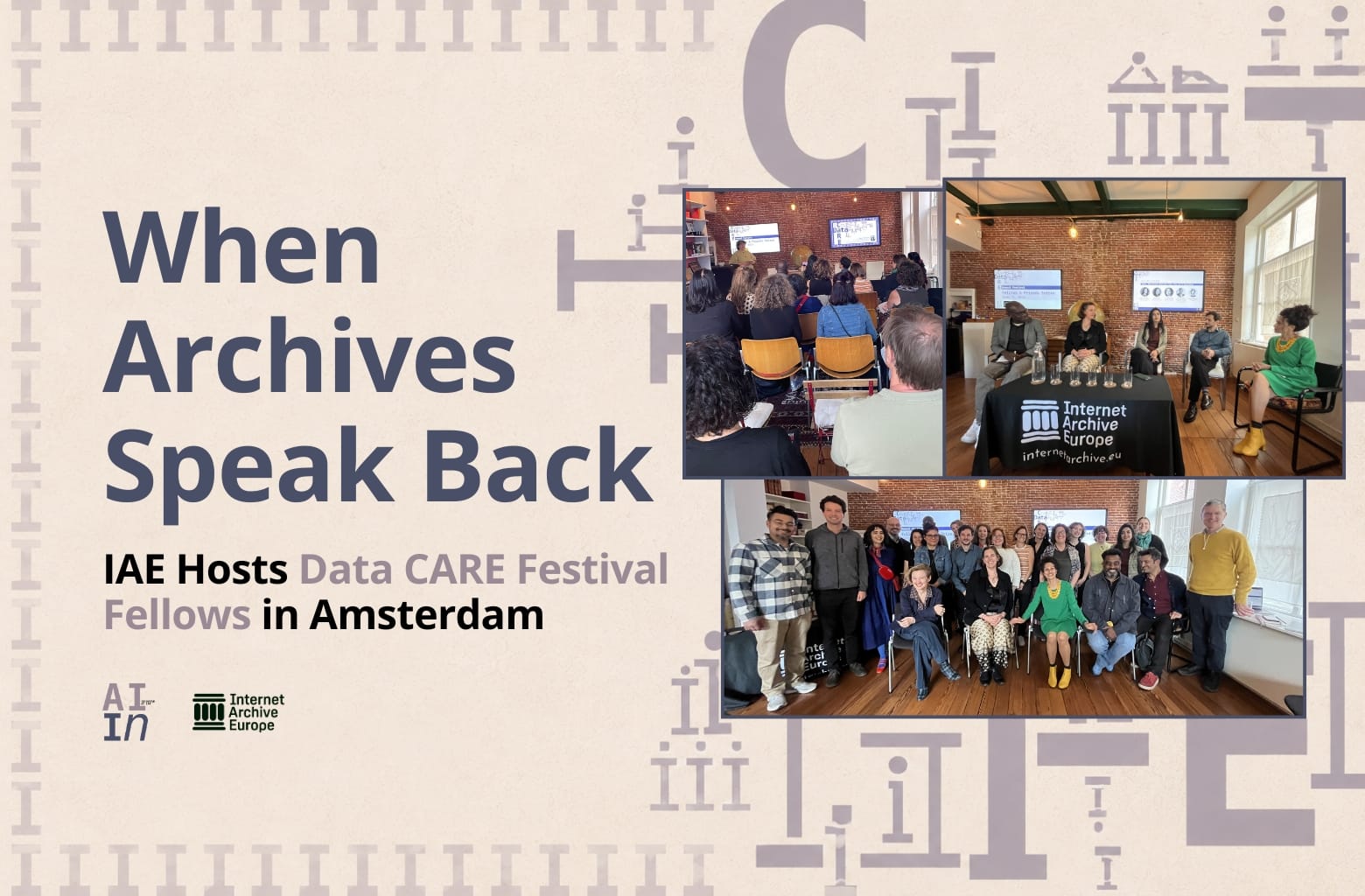
More than 30 public AI researchers from around the world gathered at the Internet Archive Europe Amsterdam headquarters on June 9 to open the Data Care Festival organized by the Inclusive AI Lab, and to discuss the role of archives in supporting culture and society.
The discussion almost didn’t happen as planned. On 9 June, Internet Archive Europe (IAE) opened its Amsterdam space for the Fellows Soirée of the Data CARE Festival, a four-day gathering organised by the Inclusive AI Lab. The listed moderator, Kirthi Jayakumar, was not able to travel to the Netherlands because of a technical error in the passport. One of the listed panelists, Franklin Ozekhome, pop culture architect and founder of Pop Culture Varsity travelling from Nigeria, also encountered entry barriers and couldn’t make it that evening. Inclusive AI Lab founder Prof. Payal Arora, stepping in to moderate, named it plainly: a visceral reminder of who gets to speak, and what kind of passport shapes access to the very conversations about power and knowledge that the evening was there to have.
The Data CARE Festival
The festival’s theme, “Reclaiming Techno-Optimism: Building for Context. Culture. Community,” reflects the core work of the Inclusive AI Lab, founded by Prof. Arora at Utrecht University. The lab incubates researchers, practitioners, and civic leaders from across the Global South and North, working on the concrete conditions under which AI can serve communities rather than extract from them.
When Archives Speak Back
The evening panel, titled “When Archives Speak Back: Power, Data, and AI Storytelling,” brought together IAE Programme Manager Beatrice Murch; Dr. Jaswina Elahi, assistant professor at Utrecht University and principal investigator on heritage-building among postcolonial migrant communities in the Netherlands; Vincenzo Scagliarini, head of research at Logotel and editor of the collaborative economy project Weconomy (Italy); and Chux Daniels, who leads transformative innovation programmes across Africa. Rana Kuseyri, responsible AI researcher at the Inclusive AI Lab, had opened the evening by framing the festival’s core commitment: not optimism as a mood, but hope as a moral imperative.
The conversation that followed was grounded in lives, not abstractions. Elahi, whose research traces the heritage of postcolonial migrant communities in the Netherlands, pushed expanded the definition of what counts as culture. Growing up Surinamese-Hindustani in the Netherlands, she described a childhood shaped by Bollywood films, Surinamese Hindustani radio, and a recurring question: but where are you really from? Her doctoral work examined how digital platforms were allowing Hindustani communities in the Netherlands to construct and transmit cultural identity — research met, early on, with the assumption that young ethnic minority internet users must be at risk of radicalisation. The actual finding was that they were using the internet to feel connected to their communities, their home countries, and their culture.
That distinction matters for what archives do and don’t capture. Elahi was precise about it: heritage is not a building or a monument. It is a song that only exists in relation to another person. It is the way a grandmother cooks that her grandchildren can attempt to learn, but will always make it differently. The body carries heritage and passes it on. The recipes communities are writing down now, the YouTube searches for ingredients that are no longer available, the heritage books being compiled: these are not the heritage itself, but they are activating something that might otherwise be lost. Data alone is not heritage. But in the right hands, it can give communities a voice they were never offered elsewhere.
Scagliarini brought a different example: a team of five engineers from different countries, working for Cisco on a creative project that eventually made it to the Venice Biennale. The team included a designer who couldn’t code. From a conventional business perspective, that was a problem. What actually happened was that she and the engineers spent a month in conversation before the first GitHub push, and she came out of it having learned a new language, not to replace her own practice, but to build shared knowledge. Data, Scagliarini argued, is something living: it can always be broken apart, rearranged, and re-interrogated, even across centuries. The responsibility is to keep rewriting it, not to take any version of the record as fixed.
Daniels traced this across a different scale. The growing global presence of Afrobeats, with the nice touch of Nigerian music playing through Schiphol airport on his last arrival, is one signal of a cultural confidence that statistics about tech governance don’t yet reflect. Eighty-five percent of the world’s population lives in contexts where the biggest tech decisions get made without them. The UK Prime Minister meeting with Apple and Google to shape AI governance is not the same as the communities in Kenya, one of the world’s biggest social media user bases, having any say in how those systems work. The same asymmetry applies to knowledge-making more broadly: innovation in agriculture, finance, and mobility is being led in the Global South by people working without the infrastructure constraints that lock the Global North into old models. M-PESA exists because banks wouldn’t go to rural areas. The most interesting AI work may be happening in places the dominant platforms aren’t looking.
Beatrice connected this to the practical stakes of what IAE and the Internet Archive exist to do. Truth, she said, is fracturing. The archive’s job, namely establishing what was said and what happened at a given point in time, matters more when that fragmentation accelerates. Democracy’s Library, the Internet Archive’s project to gather government-funded public information and make it freely accessible, is one concrete response. Beyond that, the work comes down to choices made under constraint: you cannot archive everything. The guiding principle is not to let perfect be the enemy of done, and to be honest about the challenges, which are real: lawsuits, the rising cost of storage, legal frameworks that differ across EU member states, and journalistic organisations restricting Wayback Machine access. Thirty years in, the Internet Archive is still here, and still going.
Why IAE Supports the Inclusive AI Lab
IAE is a partner of the Data CARE Festival because the questions it poses are ones we share. Who controls the record? What gets preserved, and what gets lost? When AI trains on cultural heritage, whose heritage counts? These questions shape what libraries, archives, and memory institutions can do, and what communities can access and build on. The panel on 9 June was, among other things, a demonstration that these questions are not rhetorical. Two of the people who were supposed to be in the room didn’t make it, because of where they hold citizenship. That is the context in which memory institutions operate, and the context in which inclusive AI must be built. And this is what shapes what our understanding of the past will be in the future.

