
International Archives Day falls today, Tuesday 9 June. The theme for this year’s International Archives Week is #ArchivesForJustice: Rights, Memory, and Futures. The timing is pointed.
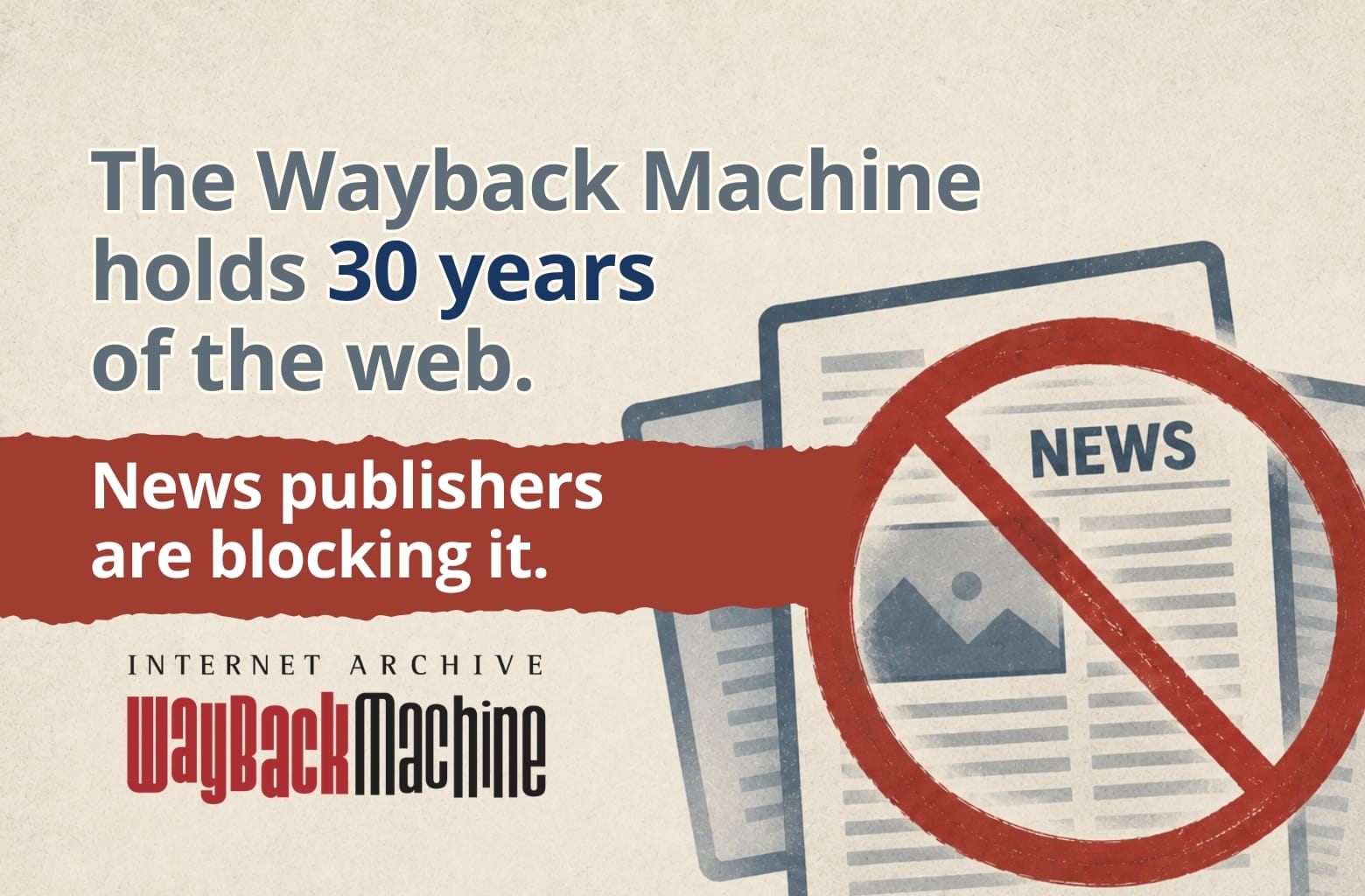
As reported by Nieman Lab and WIRED, a growing number of publishers have moved to block the Internet Archive’s web crawlers from preserving their content. For a full account of what that blocking involves and what it means, see the Internet Archive’s own FAQ on the issue.
The stated reason is artificial intelligence. Publishers are worried that content preserved by the Wayback Machine can be accessed by AI companies looking for training data. That concern is understandable. The response is not.
Blocking the Archive is not the same as blocking AI
The Internet Archive is a nonprofit digital library. It is not building commercial AI systems. It is preserving a record of history. Its Wayback Machine holds more than one trillion archived web pages and is used every day by journalists, historians, researchers, and courts.
Archived pages are often the only reliable record of how a story appeared when it was first published. Articles get edited, changed, or removed, sometimes openly, sometimes not. The Wayback Machine often becomes the only source for seeing those changes. When publishers block it, they limit not just the Archive’s ability to preserve material, but anyone’s ability to access, verify, and study journalistic and historical records in the future.
Over 250 journalists have signed the open letter
Fight for the Future has launched an open letter thanking the Internet Archive for its preservation work and calling on news organisations to reconsider. More than 250 journalists have signed.
As the letter puts it: “The freedom of journalists isn’t only the freedom to write, it’s also the freedom to have your work read and remembered for generations to come.”
The signatories include Rachel Maddow, who described the Archive as a national treasure she uses daily and cannot imagine working without. Glenn Kessler, the Washington Post’s fact-checker, described using it to examine the Trump administration’s false claims about USAID after the agency’s website was taken offline. Reuters journalist Bozorgmehr Sharafedin used it to uncover a covert CIA communication system, work that won the National Press Club’s Edwin M. Hood Award.
The Wayback Machine preserves permanent citations for nearly 5 million news articles referenced on Wikipedia. That is not a technical footnote. That is the record of public knowledge.
What #ArchivesForJustice means in practice
This year’s International Archives Week centres on accountability, memory, and the right to access the past. Archives for accountability. Archives for memory. Archives for future justice. The Wayback Machine is one of the clearest examples of those principles anywhere. It holds the web as it actually was, not as institutions later chose to present it. When publishers block it, they limit not just the Archive’s ability to preserve material, but anyone’s ability to access quality journalistic and historical records, as pointed out by the Electronic Frontier Foundation (EFF).
The Internet Archive has long worked collaboratively with publishers and respects their requests around access and preservation. What it asks is that publishers work with it, rather than against it, to ensure that the journalism being produced today remains accessible to historians, researchers, educators, and future generations.
Internet Archive Europe adds its voice to that call. The historical record belongs to everyone.Read the letter and add your voice at savethearchive.com/NewsLeaders.