
Two publications this summer put Our Future Memory in front of audiences that rarely read the same things.
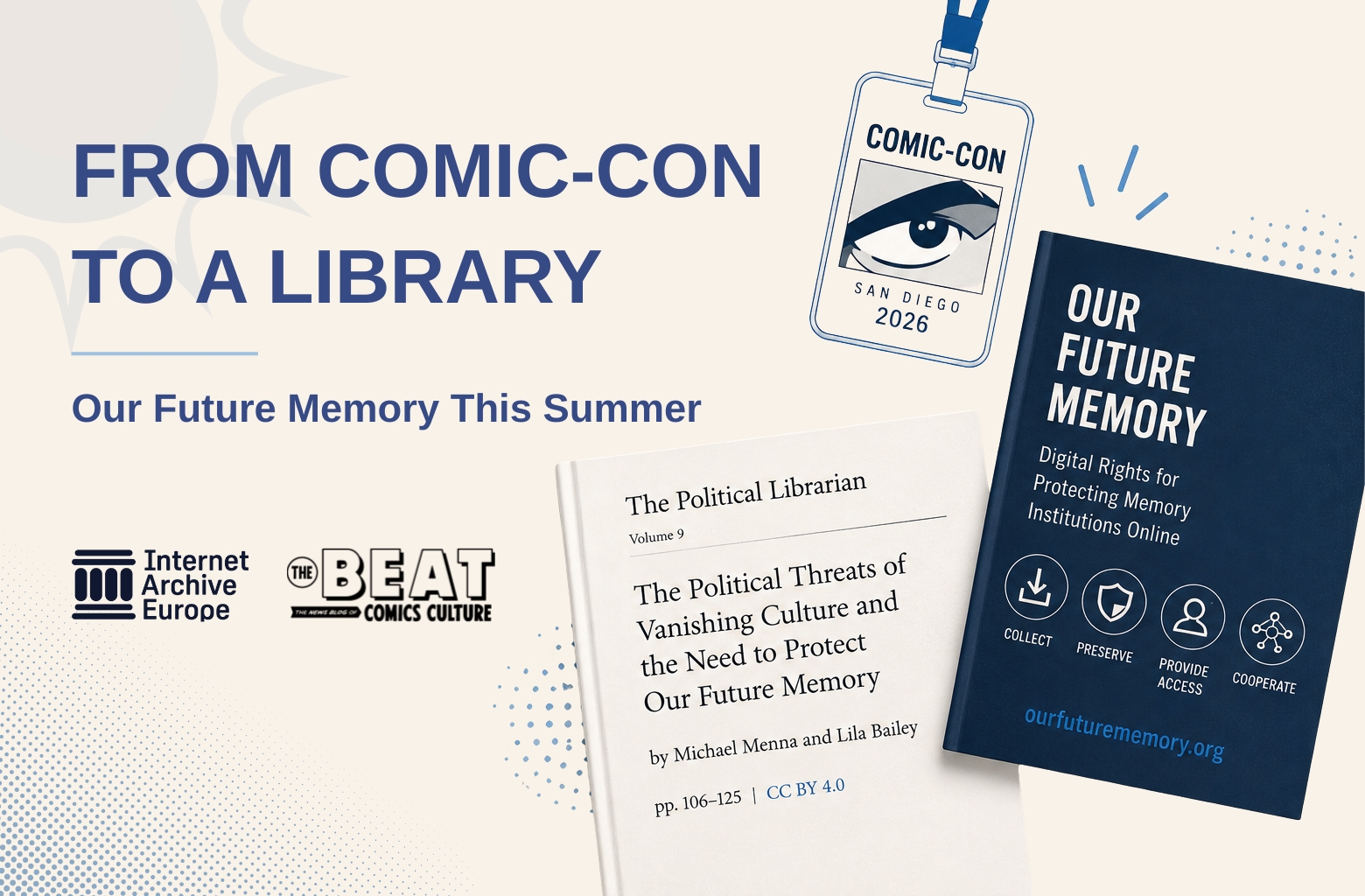
The first is a report from San Diego Comic-Con. The second is a peer-reviewed article in The Political Librarian. Between them they make a case that Internet Archive Europe (IAE) has been making for years: what happens to digital collections is a public matter, and it belongs in more conversations than the ones libraries and lawyers have with each other.
Four futures for the public library, mapped at Comic-Con
On 26 July, The Beat published an account of a talk given far from the convention’s main draw.
Daniel Rasmus, a futurist who teaches scenario planning at the University of Washington, spoke at the San Diego Public Library’s Comic-Con Conference for Educators and Librarians, which brings together the librarians and teachers who use graphic novels and manga as core literacy tools. He discussed four possible futures for public libraries in an AI-saturated 2036.
He named them Metered Commons, Cooperative Commons, Uncommons, and Stable Commons. In the first, access to knowledge sits behind licences and identity checks. In the second, communities share governance of the platforms that hold the content. In the third, automation monitors people more than it helps them. In the fourth, institutions choose predictability over speed. Four different answers to the single question running underneath all of them: who controls access once the material is digital.
Rasmus pointed to Our Future Memory as a live flashpoint in that question, and his audience understood why. Digital comics and manga sit under the same licensing restrictions that libraries meet with ebooks and databases, and graphic novels are among the most frequently banned books in the United States. He also described a planning session with the Mesa Library System in Arizona that produced a scenario he keeps returning to: an autocratic future in which librarians quietly build systems, passwords and all, so that readers can still reach banned books.
“We are storytelling creatures,” he told the room.
The Beat’s description of the campaign needs one adjustment. It presents Our Future Memory as an effort to pressure publishers to loosen their licensing terms. The ask is broader and aimed elsewhere. The Statement speaks to policymakers, and it asks for a legal framework that lets memory institutions, in the broadest sense, do their work. Licensing practice is part of the picture. The legal framework and its reach and enforcement is the larger part.
The political case for the four rights
Twelve days before Rasmus took that stage in San Diego, The Political Librarian published “The Political Threats of Vanishing Culture and the Need to Protect Our Future Memory” by Michael Menna and Lila Bailey, both writing from their work at the Internet Archive. The EveryLibrary Institute publishes the journal and is itself a signatory to the Statement. The article runs from page 106 to page 125 of volume 9, and it carries a CC BY 4.0 licence, so anyone can read it, quote it, and build on it.
The argument starts with a market shift. Books, films, music, and games used to be sold. Increasingly, they are licensed instead, and a licence can be revoked, renegotiated, or left to expire. Menna and Bailey call the result a new wave of archival ephemerality: material that was never acquired by the institution that paid for it, and that can disappear without anyone having to explain why.
The article treats this as a political question. When collections vanish, people lose the ability to educate themselves and to take part in public life on equal terms. Menna and Bailey walk through the social settings where that loss lands hardest, and they name the risk plainly: a digital dark age.
From there it returns to the Statement on Digital Rights for Protecting Memory Institutions Online and the four rights at its centre. Libraries, archives, and museums need the legal right and the practical ability to collect digital materials, to preserve them, to provide controlled access to them, and to cooperate with one another. None of this is new. Memory institutions did all four with physical collections for centuries. Those capacities should not shrink because the format changed.
The article closes with a call to action: sign the Statement, join the movement, and work together.
Why both of these matter
One of these pieces was written by a comics news site covering a convention. The other was written from inside the movement, for a peer-reviewed journal. That range is the point.
A campaign about digital rights for memory institutions can stay inside the sector that already agrees with it, or it can reach people who arrive through manga, through a public library in Arizona, through simple worry about what happens to the things they love. The second route is probably slower, but it is also the one that produces political weight.
More than seventy organisations have now signed the Statement, from the International Federation of Library Associations and Institutions (IFLA) and the International Council on Archives (ICA) to public libraries and university consortia. No organisation is too small to add its voice. If yours hasn’t signed yet, you can do so at ourfuturememory.org.
Read The Beat’s report: Why futurist Daniel Rasmus is talking to librarians at Comic-Con
Read the article: The Political Threats of Vanishing Culture and the Need to Protect Our Future Memory