
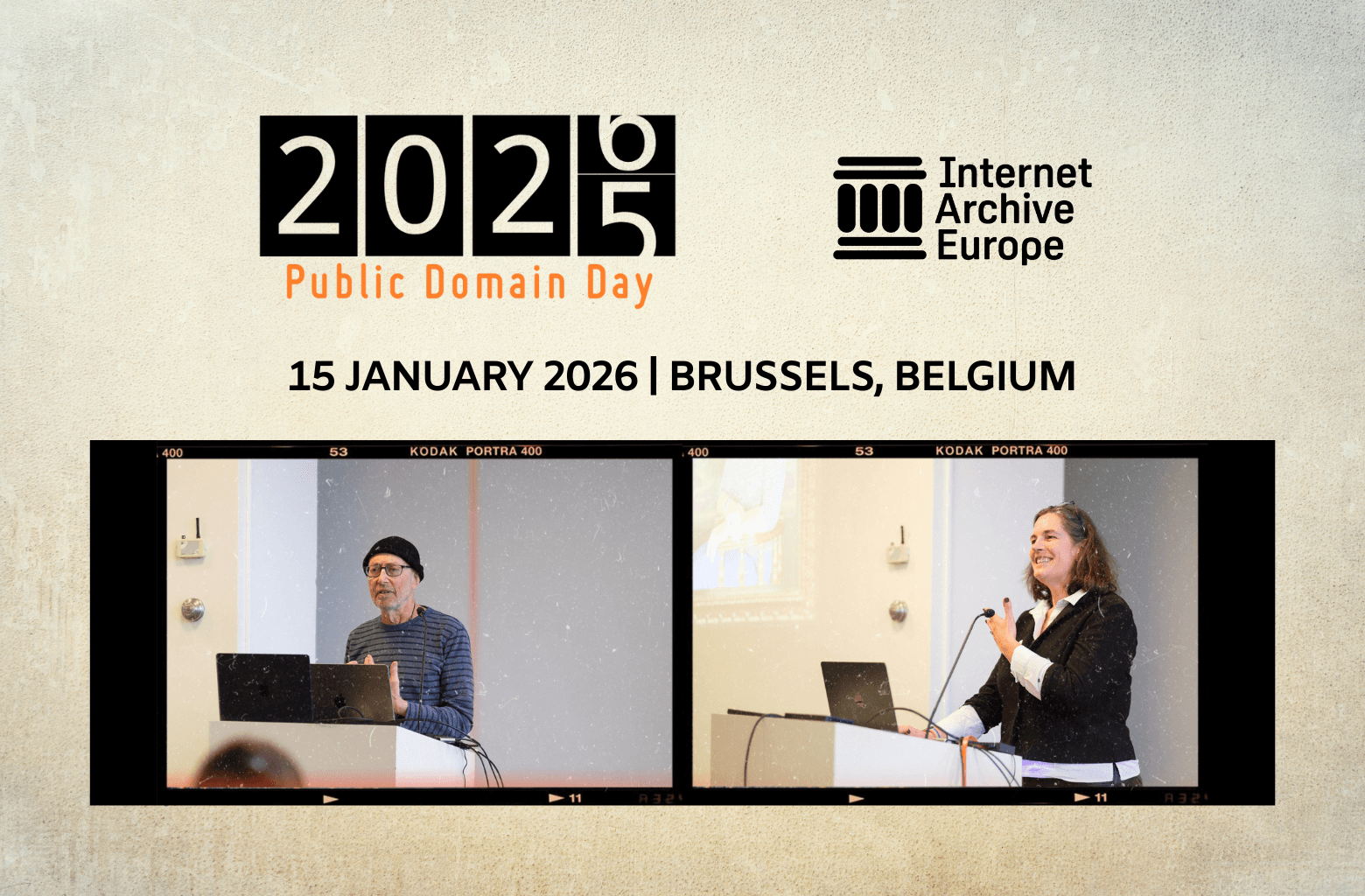
On 15 January 2026, the Royal Library of Belgium (KBR) in Brussels was buzzing with energy as we gathered for European Public Domain Day 2026. This year’s edition felt particularly special: not only did we celebrate the public domain and the works that entered it this year, but we also marked 25 years of Wikipedia—a powerful reminder of what shared knowledge can achieve when it is truly open.
From the moment the doors opened, it was clear that this was not your usual conference. It was a meeting of communities: librarians, archivists, researchers, policymakers, technologists, artists, and advocates, all united by a shared belief that the public domain is not a relic of the past but a living foundation for our future.
A Beautifully Orchestrated Day
A huge part of that atmosphere was thanks to the exceptional organisation and warm, thoughtful moderation by Camille Françoise, who guided us through a rich and ambitious programme with clarity and generosity. Together with Bart Magnus, Camille helped set the tone for a day that balanced depth with openness, and serious policy discussion with genuine enthusiasm Sebastiaan ter Burg’s technical expertise and attention to detail for both sound and vision kept the day running smoothly both on- and offline.
European Public Domain Day 2026 was made possible through the collaboration of many organisations, including COMMUNIA, Creative Commons, Wikimedia Europe, Wikimedia Belgium, Open Nederland, Europeana, meemoo, the Flemish Institute for Archives, CREATe, and Internet Archive Europe—and it truly showed what can happen when ecosystems work together.
Key Ideas That Resonated
Across plenaries, panels, presentations, and workshops, one message came through loud and clear: the public domain underpins far more than artistic reuse.
In her compelling contribution, Brigitte Vézina (Creative Commons) reminded us that protecting access to and reuse of the public domain is essential to living healthier, happier, and richer lives. As she put it, the public domain is a fundamental principle of copyright law—not just a technical category, but a condition for creativity, scientific research, education, digital equity, and cultural participation. She closed with her call to action for organisations to sign the Open Heritage Statement of which Internet Archive Europe is a proud signatory.
Other sessions explored the public domain from historical, legal, and practical perspectives: from academic reflections on its origins and boundaries, to hands-on examples of how public domain collections are reused in games, fashion, audiovisual archives, and collaborative research. The diversity of formats—from policy deep-dives to pattern-a-thons and workshops—made the day feel dynamic and inclusive.
Internet Archive Europe: Bringing Collections to Life
For us at Internet Archive Europe, it was a privilege to be part of this year’s programme and to help support the event. I was especially proud to formally present the renewed and revitalised work of Internet Archive Europe during the morning session.
Our mission—to bring collections to life—fits naturally within the spirit of Public Domain Day. Whether through preservation, text and data mining for research, controlled digital access, or collaboration between memory institutions, our focus is on ensuring that cultural heritage can be accessed, studied, and reused in meaningful ways, now and in the future.
Public Domain Day reminded us why this work matters: because access is not automatic, openness is not guaranteed, and the public domain needs active stewardship.
During my presentation, I highlighted Websites van Nederland, an innovative project developed with the National Library of the Netherlands that makes decades of Dutch web history tangible and explorable for the public. By transforming archived websites into an interactive, immersive experience, the project demonstrates how web archives can move beyond preservation alone and become powerful tools for public engagement. I was also able to share exciting news about the project’s next chapter: building on its success in the Netherlands, the model is now expanding to Canada, signaling its potential as a scalable approach to activating national web archives and connecting people with their digital past across borders.
I finally took the opportunity to issue a call to action around the Our Future Memory campaign. As memory institutions increasingly operate in digital environments, it is essential that they retain the same rights online that they have long held offline: to collect, preserve, provide access to, and share knowledge in the public interest.
In the afternoon, Bob Stein introduced Tapestries, a free and open-source tool designed to radically rethink how we explore and share digital collections. Tapestries enables anyone—truly anyone—to create non-linear, multimodal narratives that weave together web pages, PDFs, images, audio, video, and even executable code. By drawing directly on collections from Wikimedia Commons, the Internet Archive, and Europeana, Tapestries offers a powerful new way to surface and connect cultural heritage materials, turning vast digital repositories into accessible, explorable stories.
Another highlight of the afternoon was Björn Wijers’ engaging presentation on “Happy Accidents” with Public Domain films. Through playful and unexpected examples, Björn showed how working with public domain movies can lead to creative discoveries that are impossible to plan in advance—moments where reuse, remix, and curiosity collide. His talk was a joyful reminder that the public domain is not only a legal status, but a space for experimentation and surprise, echoing the spirit behind Internet Archive Europe’s Public Domain Movie Night, where shared viewing becomes a starting point for collective exploration and creativity.
Gratitude and Momentum
Most of all, European Public Domain Day 2026 was about people. The speakers who generously shared their expertise. The participants who asked sharp questions and stayed for conversations long after sessions ended. And the organisers and partners who made the day feel welcoming, thoughtful, and genuinely collaborative.
As we left KBR and continued discussions over drinks, it was hard not to feel optimistic. The challenges around copyright, digitisation, and access are real—but so is the collective intelligence and commitment in this community.
Here’s to keeping the public domain visible, protected, and alive—not just on one day in January, but every day of the year.
Check out the video recordings and the photos on Flickr

