October 2025

Europe Joins the Celebration: 1 Trillion Web Pages Preserved for Future Generations

This autumn, the Internet Archive reached a milestone that belongs to all of us: 1 trillion web pages preserved through the Wayback Machine. That’s 1 trillion glimpses into our shared digital memory — from the early homepages of the 1990s to the voices of today’s communities across the world.

As the Internet Archive marks this extraordinary achievement on 22 October in San Francisco, we invite libraries, archives, and cultural institutions across Europe to celebrate their role in making the web’s history accessible to everyone.

A Global Mission Rooted in Local Efforts

When the Internet Archive launched in 1996 with the goal of “building a digital library for the future,” few could have imagined the scale of the mission ahead. Nearly three decades later, the Wayback Machine has become one of the most widely used digital preservation tools in the world, capturing billions of web pages every month.

Each of those pages tells a story — of innovation, creativity, culture, and community. And behind every snapshot lies the dedication of institutions committed to safeguarding knowledge.

Across Europe, libraries have been at the forefront of this work: archiving national domains, documenting local histories, and ensuring that the diverse voices of our continent are not lost to time.

Europe’s Role in Preserving the Web

European institutions have long been pioneers in digital preservation — from the UK Web Archive and Bibliothèque nationale de France to Netarkivet in Denmark and numerous national and university projects across the continent.

Their collaborative spirit mirrors the Internet Archive’s mission: universal access to knowledge. Together, they ensure that Europe’s web — multilingual, culturally rich, and constantly evolving — remains accessible to researchers, journalists, and citizens for generations to come.

Celebrating the Libraries That Keep Memory Alive

To help libraries and archives join in this once-in-a-generation milestone, the Internet Archive has released a Resource Guide filled with practical tools and ideas.

It includes ready-to-use materials such as:

  • Social media templates and visuals
  • Event ideas and workshop guides
  • Impact stories from institutions worldwide

Ways Your Library Can Celebrate

Explore your community’s digital history. And help us write the next chapter of the web’s story — one page at a time.

  • Share your favorite archived webpage using hashtag #Wayback1T.
  • Create a “Then/Now” image for your library’s web site using our free Canva template.
  • Record a short video answering the question: “Why is the Wayback Machine important to you?”

As we look ahead to the next trillion, Internet Archive Europe invites libraries, cultural heritage institutions, and communities to continue working together to preserve the web, celebrate digital memory, and keep knowledge alive.

Europe Joins the Celebration: 1 Trillion Web Pages Preserved for Future Generations Read Post »
Step Into the Dutch Web of the Past: Discover “Websites van Nederland” at the KB Until “Night at the Museum” on 11 October

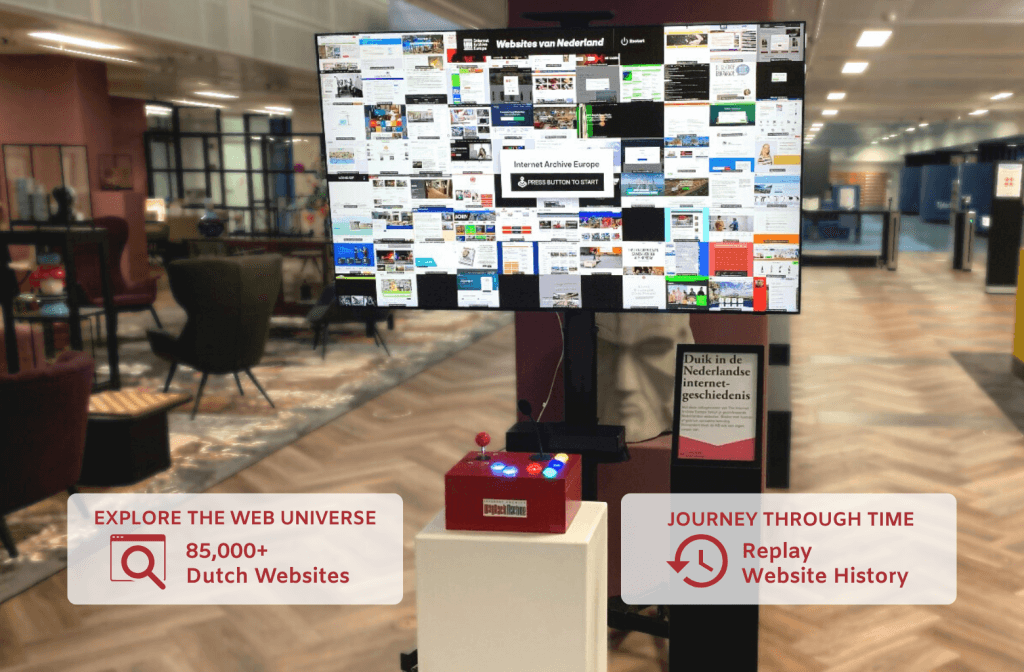
On September 17th, we were proud to unveil a new way to interact with digital history at the KB, the National Library of the Netherlands. Our new interactive installation, “Websites van Nederland: explore the web of the past,” is now open to the public, offering a playful and profound journey into the Dutch internet archive.

The response has been fantastic, affirming our belief that this machine is more than just a tool. As we noted at the launch, it’s a tangible expression of our vision to place our collective memory directly at each individual’s fingertips, demonstrating how digital preservation is not about storing data in the abstract, but about making the richness of the past immediately usable, searchable, and alive.

A Universe of Dutch Culture

Internet Archive Europe Open House, 19 September 2025” by Sebastiaan ter Burg, CC BY 4.0

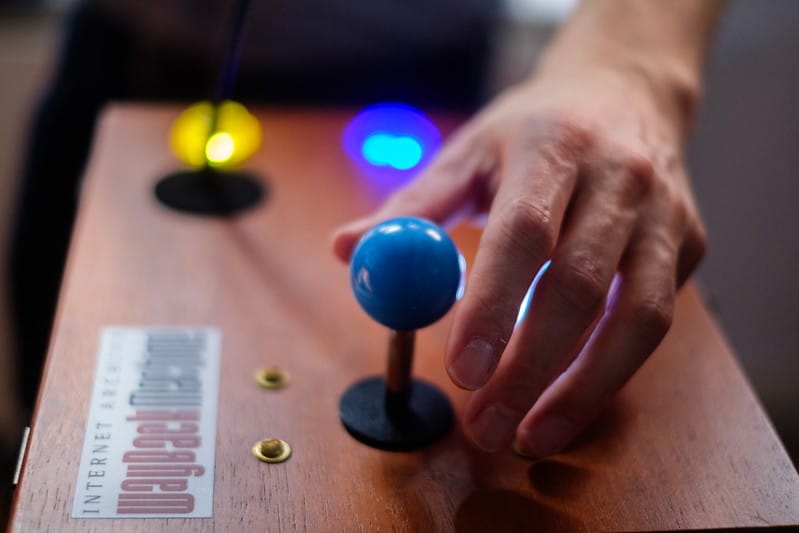
The installation immerses visitors in a visual galaxy of 85,000 Dutch websites, drawn from over 1.2 million archived snapshots captured between 1996 and 2025. Using a physical joystick and buttons, visitors can fly through this vast digital universe, discovering the incredible diversity of the nation’s web landscape. The gamified experience encourages curiosity, while powerful voice search allows users to pinpoint specific topics or domains.

A Time Machine at Your Fingertips

Beyond exploring the sheer vastness of the archive, the installation is a powerful time machine. Visitors can select any website and instantly replay its history, flipping through archived versions to watch it evolve over the years. This feature makes the concept of a web archive tangible, showing how websites lived, breathed, and changed. To make the experience personal, a QR code lets visitors send any discovered website directly to their mobile phone to explore further.

A Blueprint for Europe’s Digital Heritage

While this first installation celebrates the Dutch web, it serves as a powerful blueprint for all of Europe. The technology and concept behind “Websites van Nederland” are designed to be adaptable. Imagine a “Websites of France” in Paris, or a “Websites of Italy” engaging visitors in Rome.

This is central to Internet Archive Europe’s mission. We aim to create engaging ways for citizens across the continent to connect with their own unique digital histories. This project shows that it’s possible to transform national web archives from static repositories into dynamic, interactive public experiences.

This is what “bringing collections to life” truly means. By connecting people with the traces of their own digital past, we empower them to understand the present and imagine the future. We believe this is essential work to ensure Europe’s digital memory is not only safeguarded, but also activated, accessible, and meaningful to all.

We invite you to visit the KB and experience “Websites van Nederland” for yourself. The installation will be on display until 11 October, culminating in The Hague’s Museum Night. Come and play with the past!

Photo credits featured image:Preserving Digital Sovereignty: Marleen Stikker & Brewster Kahle at the KB” by Sebastiaan ter Burg, CC BY 4.0

Step Into the Dutch Web of the Past: Discover “Websites van Nederland” at the KB Until “Night at the Museum” on 11 October Read Post »

New Dutch & Papiamento Translations of the “4 Rights” Statement — and a Call to Every Memory Institution to Sign

We’re pleased to announce that the Our Future Memory “4 Rights” statement has now been translated into Dutch and Papiamento, thanks to the generous work of Biblioteca Nacional Aruba and Maarten Zeinstra from IP Squared.

This is a wonderful moment of collaboration, and we extend our deepest gratitude to our partners for helping to spread this vital message. These translations enable the statement to reach more institutions, stakeholders, and decision-makers in Dutch- and Papiamento-speaking communities. You can read the newly translated versions and sign the statement at ourfuturememory.org.

Internet Archive Europe is now also a signatory to the “4 Rights” statement. “By endorsing the 4 Rights, we’re reaffirming that universal access to knowledge isn’t a slogan—it’s a shared responsibility. Achieving it requires clear rights, workable rules, and practical collaboration across borders,” said Tony Guepin, Board Member, Internet Archive Europe.

Voices from Aruba

Peter Scholing, Head of Digital Collections and Research: “In April of 2024, this statement was first signed in Oranjestad, Aruba, by memory institutions from Aruba and the rest of the Kingdom of the Netherlands. By making the Digital Rights Statement available in both Papiamento and Dutch we renew and confirm our commitment to universal access to information, and emphasize that we as memory institutions have an important role to play in this, by actively providing access to the digital and digitized information that is relevant and important to our communities and local audiences. It starts with (re)claiming our digital rights.”

Ichmarah Kock, Digital Collections and Information Management: “Heritage collections in Aruba are often fragile and scattered. When we at Aruba’s National Library digitize these collections, we are reminded that heritage does not belong to a single institution but to the people. The Digital Rights Statement ensures that everyone has the right to access, reuse, and reimagine our heritage without barriers.

Having the statement available in Papiamento is powerful because it shows that our rights to (digital) knowledge and culture are not abstract ideas, but part of our own language and our own way of seeing the world. With the Statement becoming available in Papiamento we also extend an invitation to other ‘lesser-known’ languages. They too deserve space and visibility, whether in physical or digital collections.

In my work, I see how digital collections come alive when the public engages with them. From old newspapers to photographs of daily life, each item we digitize is a piece of who we are. It is important that people can not only find digital information, but also trust that it remains free, open, and safe for future generations. The Digital Rights Statement ensures that these pieces remain accessible and guarantees that people in Aruba are not just users but co-creators of our future collective memory.”

Yorleny Oduber-Quesada, Information Specialist, Special and National Collections: “Papiamento represents both identity and dignity. To safeguard the future of our communities and the wider world, it is imperative that we secure the right to digital information for all people — without barriers of language or geography.” = In Papiamento: “Papiamento ta un idioma di identidad y dignidad. Pa proteha e futuro di nos comunidad y di mundo, nos mester garantisa derecho di acceso na informacion digital pa tur hende, sin limitacion di idioma of luga.”

Why Your Signature Truly Matters

You might think: “My national or regional federation has already signed this via IFLA or another body — do I still need to sign?” The answer is: yes. Here are a few reasons why:

  • More signatures = stronger message
    When policymakers see a broad base of institutions — not just large federations — endorsing the statement, it sends a powerful signal that these rights matter on the ground, day in and day out.
  • Local relevance & accountability
    Your institution’s signature shows that you, locally, accept these principles and expect them to be respected in your jurisdiction. It’s not just theoretical or distant; it’s part of your institutional agenda.
  • Amplification and visibility
    Every additional signatory spreads awareness in its own network. That raises the chances that local ministries, cultural heritage bodies, funders, and legislators will pay attention.
  • Diversity strengthens legitimacy
    When small, mid-sized, and large institutions from different countries and contexts sign, it demonstrates that the 4 Rights are relevant across many settings—not just for large institutions.

In short, whether your institution is large, small, national, local, specialized, or generalist — your voice adds weight.

  1. Visit the Our Future Memory website at ourfuturememory.org and go to the “Sign the Statement” page.
  2. Sign up your institution: Print the statement and sign it by hand or fill it in electronically using an Adobe-compatible tool and email it to campaigns@internetarchive.eu
  3. Share the announcement via your communication channels: newsletters, social media, partner networks.

Let’s show the world that the future of memory is a cause that unites us all. Stand with us, add your name, and let’s make our call for change impossible to ignore.

Sign the Statement Today!

New Dutch & Papiamento Translations of the “4 Rights” Statement — and a Call to Every Memory Institution to Sign Read Post »

Scroll to Top